Cardio-oncology
Cancer therapies can have unintended effects on the cardiovascular system, increasing the risk of cardiac dysfunction, arrhythmias, and heart failure in cancer survivors. Our research focuses on understanding the molecular mechanisms that drive cancer therapy-associated cardiotoxicity and identifying novel strategies to protect the heart without compromising anticancer efficacy.
Projects
p38 Mitogen-Activated Protein Kinases (MAPKs) Modulate Doxorubicin Cardiotoxicity in an Isoform- and Sex-Specific Manner
Doxorubicin is an anthracycline antibiotic used in cancer chemotherapy. Despite its well-documented cardiotoxic effects, it is still widely used in the clinic by limiting the therapeutic dosage. It is therefore crucial to identify strategies to protect the heart from the life-threatening side effects of doxorubicin. To identify cardioprotective approaches, it is first necessary to understand the mechanisms that underlie cardiotoxicity. Doxorubicin-induced cardiotoxicity (DIC) is associated with increased production of reactive oxygen species (ROS), activation of stress signaling pathways, DNA damage, metabolic dysfunction, and mitochondrial damage. Stress-activated signaling molecules, particularly p38 MAPKs, are well-known regulators of DIC. However, the isoform-specific roles of the four mammalian p38 MAPK family members, p38α, p38β, p38γ, and p38δ, in DIC remain incompletely understood. Our research aims to elucidate the roles of p38 MAPK isoforms in DIC, using both generic and pharmacological approaches.
We have found that systemic genetic deletion of p38δ protected female mice against DIC, improving survival and cardiac function, reducing fibrosis, and increasing autophagy. In contrast, deletion of p38γ had no significant effect on DIC. Additionally, we found that cardiomyocyte-specific deletion of p38α is protective in male mice, whereas systemic deletion of p38β was detrimental in female mice during DIC. We are currently investigating the therapeutic potential of RNA interference (RNAi)-mediated p38δ silencing for mitigating DIC in female mice and are working to translate these findings to human physiology using an ex vivo human left ventricular cardiac slice model.
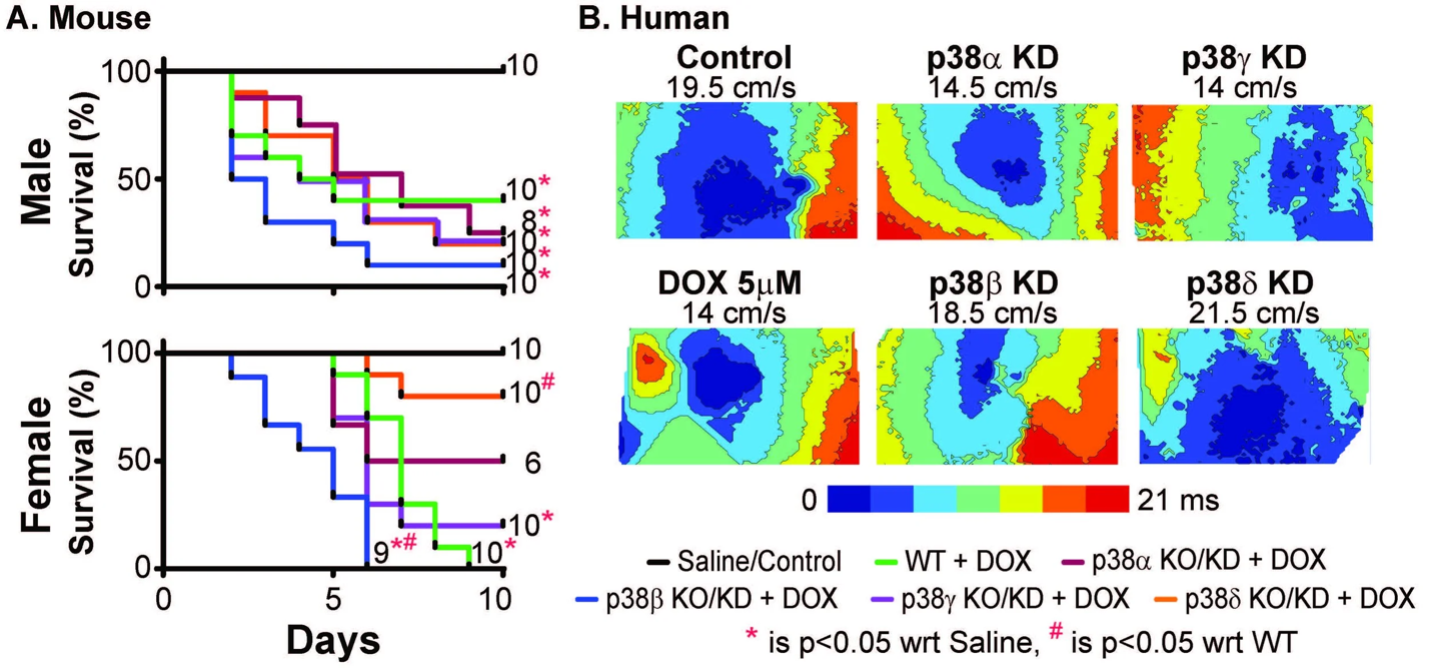
Isoform-specific roles of p38 MAPK signaling in anthracycline cardiotoxicity. (A) Survival of male and female mice following doxorubicin (DOX) treatment reveals distinct effects of p38 MAPK isoforms on cardiotoxicity. (B) Human cardiac tissue activation maps demonstrate isoform-specific effects of p38 knockdown on conduction velocity after DOX exposure.