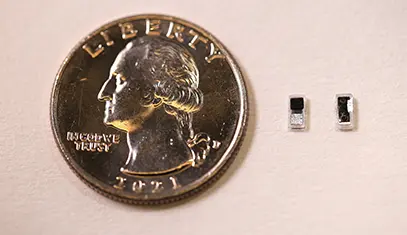
Millimeter-scale pacemaker next to a quarter dollar.
Bioelectronic technologies are transforming the prevention, diagnosis, and treatment of cardiovascular disease by enabling physiological monitoring and targeted modulation of cardiac function. At CVET, we develop next-generation bioelectronic platforms, including implantable sensors, cardiac pacemakers, flexible biointerfaces, and multimodal systems for high-resolution cardiac mapping and stimulation. These technologies aim to improve disease detection, advance our understanding of cardiac electrophysiology, and enable more precise therapeutic interventions.
Observation and regulation of cardiac function are essential for understanding mechanisms underlying both normal physiology and disease. The Efimov lab, through extensive collaborations, has developed next-generation pacemakers and defibrillators that are fully implantable, wireless, and bioresorbable. These devices naturally dissolve inside the body after use, eliminating the need for surgical removal. The latest generation features a millimeter-scale, battery-free design that can be activated on demand using near-infrared light. We also work on developing AI-enabled, organ-conforming devices to treat atrial and ventricular arrhythmias. This miniaturized platform represents a major breakthrough in pacemaker technology, enabling minimally invasive implantation.
Millimeter-scale pacemaker next to a quarter dollar.
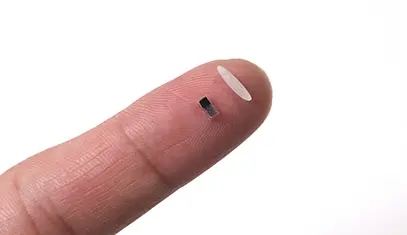
Millimeter-scale pacemaker next to a grain of rice.
Continuous monitoring of cardiac physiology—including electrical and mechanical signals, hemodynamics, and respiration—is fundamental to both clinical patient care and preclinical studies of disease mechanisms. The Efimov lab is developing a range of novel implantable bioelectronic sensors, including miniaturized devices for continuous monitoring in freely moving small-animal models, as well as implantable epicardial and intravascular sensors designed to improve prognosis and management of arrhythmia, metabolic disease, and heart failure.
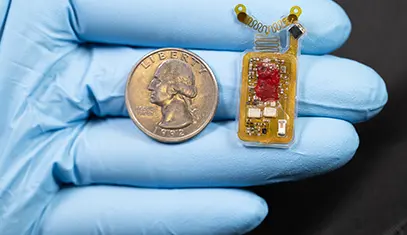
Implantable multiparametric cardiac sensor next to a quarter dollar.
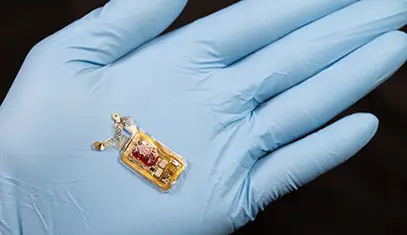
Implantable multiparametric cardiac sensor.
The soft and lightweight biointerfaces are made of graphene via simple, scalable fabrication methods. These graphene-based devices enable high-fidelity recording of cardiac electrical activity (e.g., sinus rhythm and arrhythmia) and effective cardiac pacing when implanted on the heart or nerves. The transparency of graphene also enables the integration of such a device into optocardiography to track and modulate heart rhythm using light, further expanding its application scenarios.
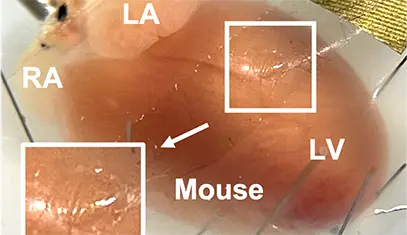
Anatomical views of the mouse heart. The inset maginfied area on the heart texture corresponds to the epicardial region.
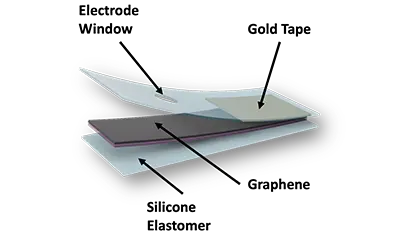
Bioelectronic sensor stack components.
Soft, scalable, and multifunctional cardiac technology integrating multilayered colocalized m-electrodes and m-LED arrays for site-specific optogenetics and electrical modulation. Ex vivo and in vivo demonstrations support the functionality of cardiac mapping and stimulation, with applications ranging from basic to clinical cardiology. Such devices can provide multiplex mapping of cardiac electrical activity, and by switching different channels to stimulation mode, they can also pace the heart from different cardiac regions.
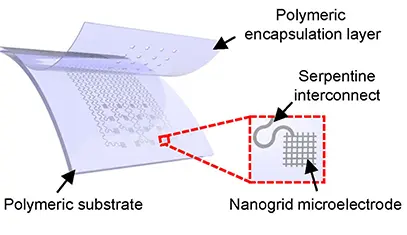
Diagram of a flexible bioelectronic patch showing the polymeric substrate, an encapsulation layer, a serpentine interconnect, and a nanogrid microelectrode inset.
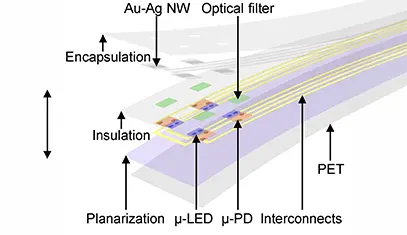
Exploded-view technical diagram of a flexible optoelectronic device stack, detailing layers from PET substrate to encapsulation, alongside micro-LEDs, micro-PDs, optical filters, and interconnects.
Cardiac resynchronization therapy (CRT) is a widely used effective treatment modality for patients with symptomatic drug-refractory heart failure, but 30-40% of those treated do not respond favorably. Conduction-system pacing is a more physiological approach to CRT because it can overcome the limitations of biventricular pacing by directly engaging the heart's intrinsic electromechanical sequence.
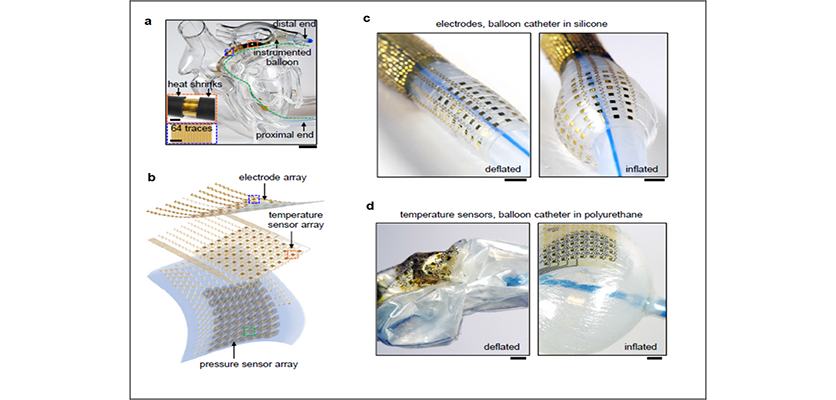
A novel conformal bioelectronic device is being developed to precisely map, ablate, and achieve selective left bundle branch pacing in which electrical activation will occur directly over the His-Purkinje system, utilizing the integrated balloon pacing-ablation-mapping (PAM) catheter delivery system.